
~The potential of Japanese-English bilingual education, where cross-cultural experiences inspire children to want to communicate~
In June 2025, children from Hawaii joined a short-term study abroad program at elementary schools in Japan.
- Safe and reliable support through collaboration with the local Board of Education and travel agencies
- Many parents and teachers noticed that children spoke more Japanese after returning home
- Applications for this year, click here
A Hands-On Study Abroad Experience in Japan for 7 Elementary School Students
From June 8 to June 17, 2025, seven children from Hawaii participated in a study abroad exchange program in Higashikagawa City, Kagawa Prefecture, Japan.
The 10-day program gave children the opportunity to experience real life in Japan through all five senses, including:
- Attending classes at local elementary schools
- Taking part in Japanese cultural experiences
- Enjoying sightseeing activities
- Visiting local factories and learning about the region
There were two accommodation options:
- Staying at a hotel with a parent
- Homestaying with a Japanese host family without a parent
In both cases, participants were able to join with peace of mind thanks to the support of professional staff from the local Board of Education and travel agencies.
Experience Everyday School Life in Japan
One of the greatest strengths of this program is that children can experience everyday school life in Japan, just like local Japanese students.
At each elementary school they visited, the children were welcomed with special events organized by the students. They were also given opportunities to naturally take part in everyday routines such as school lunch, cleaning time, and brushing their teeth after meals.
Highlights included:
- Visiting classrooms and eating school lunch with Japanese students
- Taking part in classroom cleaning and toothbrushing routines
- Experiencing “everyday Japan” in a natural and authentic way
- Joining welcome events in the gymnasium, including English songs, dance performances, and mini sports day activities
- Playing traditional Japanese games such as hagoita and kendama together with local senior community members
For the children, it was a valuable opportunity to feel as though they had truly become Japanese elementary school students, while naturally engaging with both Japanese language and culture.
Japanese Came Out Naturally: A Memorable Experience at Toramaru Puppet Land
Another especially memorable part of the program was the visit to Toramaru Puppet Land.
This unique museum displays puppets that were actually used in NHK productions and other performances. The children were able to touch the puppets and play with them freely.
One of the adults shared the following impression:
“It was so fascinating that children whose first language is English somehow started speaking in Japanese when they were playing with the puppets.”
Another said:
“I was surprised to hear them saying things like, ‘This is ___!’ in Japanese while they were playing.”
As the children created stories through puppet play, Japanese began to come out naturally. This ability to draw out spontaneous language is one of the most special strengths of the program.
Why Did the Children Start Speaking More Japanese After Returning Home?
The children who joined the program normally live in English-dominant environments. Even so, after returning home, many parents and teachers reported a clear increase in Japanese output.
Some comments included:
“My child usually speaks mostly English, so I was surprised when they started telling me in Japanese, ‘This happened in Higashikagawa!’”
“They naturally shifted into Japanese mode when talking with their Japanese teacher.”
In just 10 days, the children’s language brains seemed to switch into “Japanese mode.” This is also a sign that real-life interactions and daily experiences helped nurture a desire to communicate and share their thoughts in Japanese.
10-Day Program Schedule
The program followed a schedule like the one below:
Kodomo Gakushu Kyoshitsu Study Abroad Program – 2025 Schedule
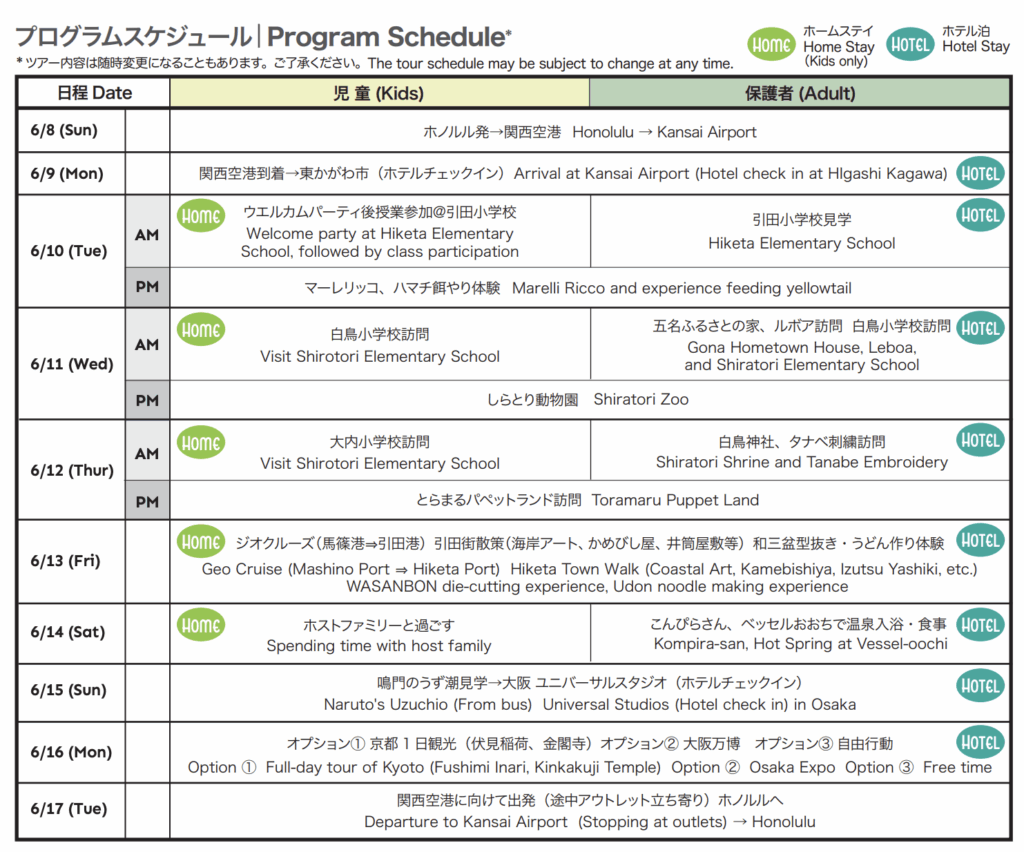
Please note:
The visit to Gomyo Furusato no Ie, originally scheduled for Wednesday, June 11, was canceled and replaced with a local glove factory tour and a history learning activity.
Parents Were Delighted Too: A Program That Combined Sightseeing and Learning
While the children were attending school in the mornings, a separate program was also prepared for parents.
Parent activities included:
- A hands-on experience making Wasanbon, a traditional Japanese sugar sweet
- A tour of a long-established soy sauce brewery with over 300 years of history
- Visits to one of Japan’s leading glove factories and embroidery manufacturers
- Cultural tours featuring temples, hot springs, and regional cuisine
In the afternoons, parents reunited with their children and enjoyed tourism activities together. The schedule was designed so that the whole family could experience and enjoy Japanese culture.
A Strong and Reliable Support System
This program was operated in cooperation with the following organizations:
- JAAC (Japan-America Academic Center)
- Higashikagawa City Board of Education
- Crescendo Tours
- HIS
All staff members were bilingual in Japanese and English. Multiple support staff accompanied participants throughout the program, and emergency medical support was also in place.
The Program Is Planned Again for 2026, with More Spaces Available
This year, seven bilingual children raised in English-speaking environments joined the program. Next year, the program is expected to expand to up to 20 participants.
The program is open to elementary school students living in Hawaii and the U.S. mainland. Japanese and English ability are not required, although there are age requirements.
For families interested in homestay, the local Board of Education will match children with trusted host families.
Conclusion: Bilingual Education That Cannot Be Learned from a Desk Alone
Playing, eating, cleaning, and speaking in a real Japanese school setting—
this kind of direct experience of everyday life in Japan is at the heart of bilingual education.
Rather than learning Japanese only as a school subject, children begin using Japanese because they want to express themselves.
This program allows children to absorb both language and culture with their hearts and bodies, not just through textbooks. We hope you will consider joining this meaningful experience.