~A new style of bilingual education where children can enjoy experiencing both Japanese language and Japanese culture~
For families raising children in Hawaii or on the U.S. mainland, do any of these concerns sound familiar?
- You want your child to learn Japanese, but it is difficult to do that through home life alone
- You want your child to experience Japanese traditions and culture as well
- You hope your child will grow up bilingual, able to speak not only English but also Japanese
- You are looking for a Japanese language school, but have not yet found an environment where your child can enjoy learning and continue comfortably
For families like these, we would like to introduce one of the special programs offered at our school: our online exchange lessons with a preschool in Japan.
This program is a new form of bilingual education that allows children to experience both language and culture naturally and joyfully.
Why Did We Start This Program?
A New Form of Exchange Born During the Pandemic
This program is held between our school in Hawaii and Kyoshin Hoppa, a bilingual preschool in Japan with campuses in Kyoto and Setagaya.
It began during the COVID-19 pandemic. At a time when real, in-person international exchange became difficult, we wanted to create a space where children could still connect with the world—even through a screen. That is how this online exchange program was born.
At our school, we support children in Hawaii who are learning Japanese. At Hoppa Preschool, they support children in Japan who are learning English. Because both schools place strong importance on bilingual education, the conversations between the children feel natural, and even in a short amount of time, they can truly feel that they are communicating with one another.
What Happens in the Online Exchange Lesson?
A typical lesson may include:
- Greetings with a Hello Song in English
- A vocabulary game in which children memorize and present items related to spring and the new school year
- Closing with a Goodbye Song in Japanese
In our online exchanges, we always include seasonal themes and age-appropriate topics related to the time of year.
In this particular game, children used items connected to spring and the Japanese school year, such as:
- Cherry blossoms
- Pencils
- School uniforms
These topics help children experience Japanese culture in a natural and meaningful way.
During the game, children look at a picture for 30 seconds and try to remember what they saw. The children in Japan present their answers in English, while the children in Hawaii present theirs in Japanese.
The children eagerly raised their hands, excited to answer and challenge themselves with new words. There were also many moments where they worked together naturally, saying things like, “Wasn’t it this one?” or “I think it was that!”
As the lesson continued, the classroom filled with lively, joyful energy.
It has also been especially meaningful to see how repeated exchanges spark natural curiosity in the children. Comments and questions such as, “They look like they’re wearing warm clothes,” or “What is sakura?” begin to come up on their own.
For children in Hawaii, who do not always experience four distinct seasons or the Japanese school-year culture firsthand, this program offers a valuable chance to understand Japanese seasonal life in a more experiential way.
Real Conversations Led by Children—Even Online
Our online exchange lessons are not simply about talking through a screen.
Before each session, the teachers meet two or three times in advance to carefully plan the vocabulary, theme, and structure of the activities. This preparation allows the children to engage in real conversations using their own words, rather than just repeating memorized phrases.
In past exchanges, we have also included two-way presentations such as:
- Children in Japan introducing Japanese culture in English
- Children in Hawaii explaining Hawaiian food culture in Japanese
For example, Hawaii-based students have tried to explain foods that are less familiar in Japan, such as:
- Starfruit
- Maguro zuke-don (marinated tuna rice bowl)
Watching children work hard to explain these foods in Japanese shows not only their vocabulary growth, but also their ability to communicate clearly and share cultural ideas with others.
Positive Feedback from Families in Hawaii
This exchange lesson is available free of charge and with no additional registration required for students already attending our school.
We have even had parents whose trial lesson happened to fall on the same day as the exchange class say things like,
“I had no idea there was such a unique program like this.”
The content of the games changes with the seasons, but the format stays generally the same. Because of this, children do not need to spend energy learning new rules each time. Instead, they can focus on what matters most: learning and using Japanese.
A Warm Connection That Reaches Across the Ocean
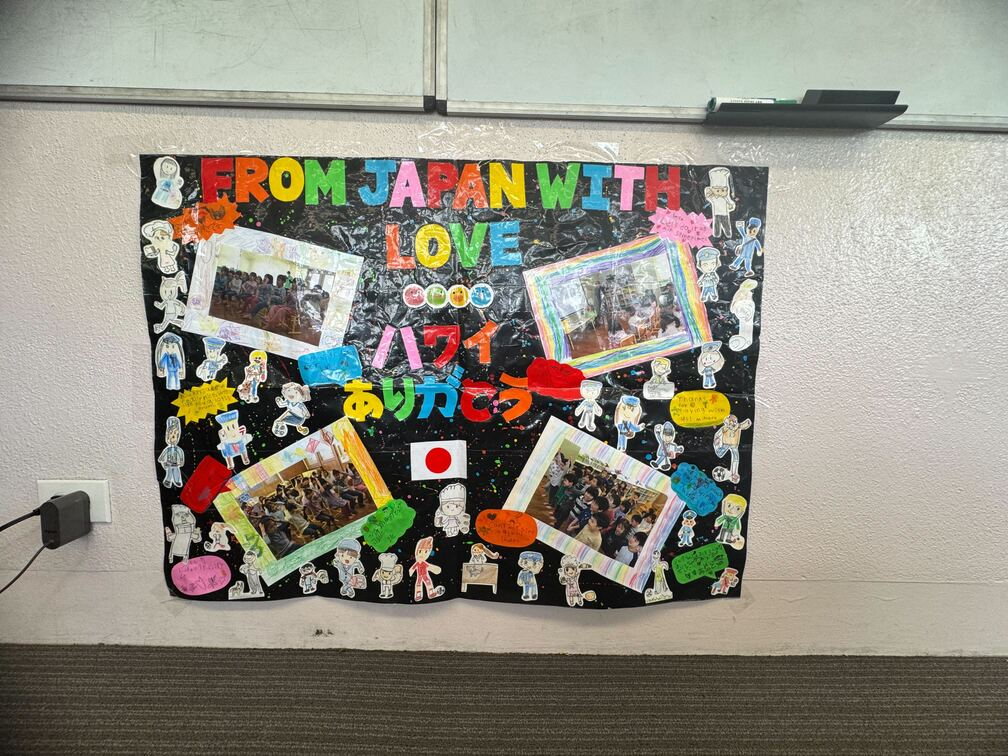
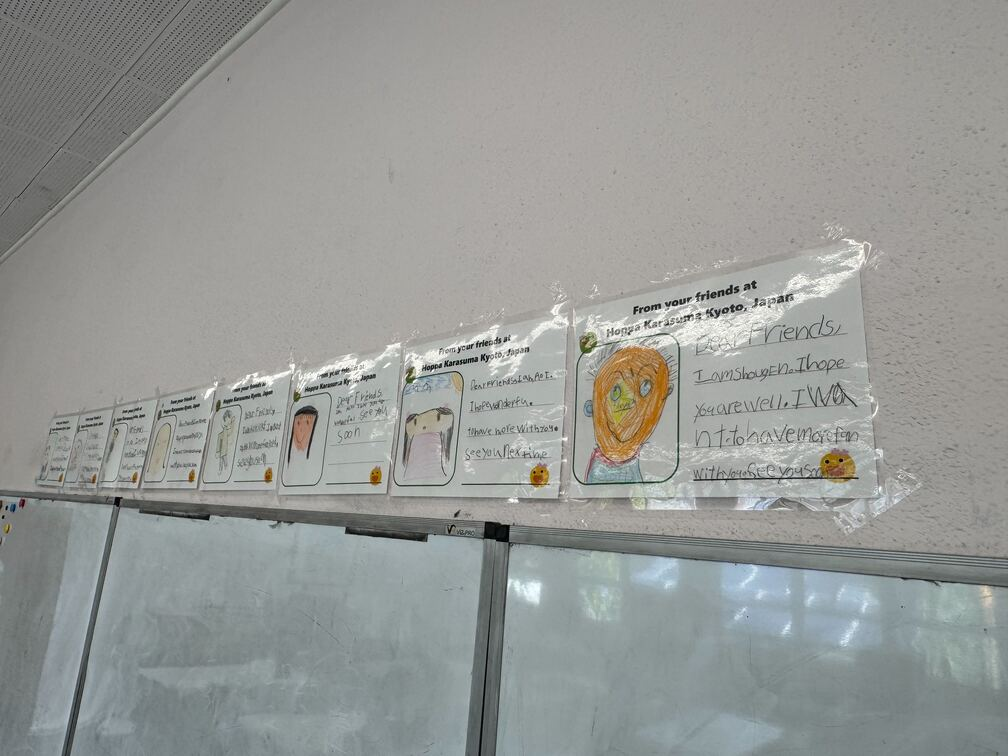
After this exchange, we also received a handmade poster from Japan filled with kind messages from the children.
The poster included both English and Japanese, and the warm words of friendship brought a smile to our faces. These small but meaningful exchanges remind us that children can build real emotional connections, even online.
Conclusion: Even in Hawaii, Children Can Have Meaningful Time Connected to Japan
When living overseas, opportunities to experience Japanese language and culture can naturally become limited.
What we aim to create is not just learning through textbooks and worksheets, but a place where children can feel the “living present” of Japan through real interaction and experience both language and culture in an authentic way.
In fact, there are still very few schools that offer this kind of ongoing, interactive online cultural exchange on a regular basis.
Some other schools may have similar programs, but in many cases, the language gap between the children is too large, and teachers must act as interpreters throughout the lesson.
That is what makes our program with Hoppa Preschool so special. Because both sides are learning in bilingual environments, the children are able to communicate with each other much more naturally.
We hope to continue providing experiences that help children feel a real, living connection to Japan—even while growing up in Hawaii.
Looking for a Japanese Language School or Bilingual Learning Environment in Hawaii?
If you live in Hawaii and are looking for a Japanese language school, a bilingual education environment, or a place where your child can enjoy learning Japanese and Japanese culture, we would be happy to hear from you.
Please feel free to contact us, even if you would simply like to start with a trial lesson.